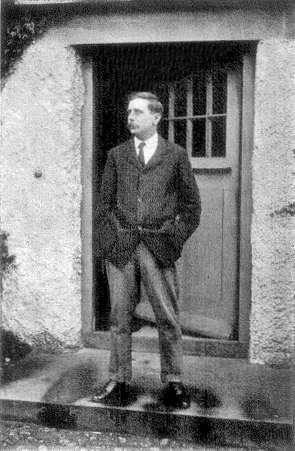
 Science fiction, much like many children growing up in homosexual households, has two fathers. (One could make the obvious joke that that's why science fiction is so gay, but I find that joke in poor taste and will refrain from using it.) These two fathers are, of course, Jules Verne and Herbert George Wells, more commonly referred to as H.G. Wells.
Now, we all know science fiction had other writers before these two. It's generally agreed that the oldest work of science fiction dates back to the 2nd century, with Lucian's True History, though it differs greatly from what we would consider science fiction today. One can see elements of the genre in Gulliver's Travels by Swift, which is from the 18th century. One of the earliest manifestations of the genre as we know it today would be Mary Shelley's Frankenstein. And, of course, let us not forget Mr. Poe's works of science fiction as so many other people tend to do. But I'm not here to discuss science fiction, so much as one of its fathers.
 There always seems to be a bit of a debate as to who was the better science fiction writer: Verne or Wells. I think a large part of who you choose is determined by which one you grew up on, though I'll not voice my opinion of who is the more superior author.
Wells, on the other hand, I did not even attempt until I was a bit older. Not that I thought it'd be too difficult, but he was an author who never really suggested himself to me. He stood back quietly and awaited my arrival. I was twenty the first time I read War of the Worlds. I was in Indiana at the time, which was when I mostly read nothing but C.S. Lewis. Wells stuck with me though. It wasn't until 2006 that I began reading other works by him. There are two used bookstores in my home town. They're right next to each other so I would always stop at one and then walk down to the other. Between the two, I found a good selection of books by Wells. All the well known titles, but also some more obscure ones, such as In the Days of the Comet and The First Men in the Moon, which is my favorite. I devoured them. Wells is the only author, saving C.S. Lewis, that I have devoted to reading so wholeheartedly, as I read him without stopping to read anyone else.
I hit a wall though when I began reading When the Sleeper Wakes, republished later as The Sleeper Awakes. I can't tell you why, but to this day, it's one of the few books I started and never finished. The story was interesting--a man stays awake for a long period of time and then sleeps for two hundred and three years. The writing was as good as any other Wells novel. But, I couldn't find an interest in it. My love affair with Wells had ended.
This was not too long ago--November of 2007, if I remember correctly--because When the Sleeper Awakes was a late find for me. I tried to read it again in the summer of 2008 and had the same difficulty. Perhaps I should've simply started on a different Wells novel--The Food of the Gods had recently shown up at one of the bookstores--but instead, I moved on to other things. That was the year I really got into Charles Dickens, and my interests had shifted from science fiction to the more realistic novels of the Victorian period (comparatively more realistic).
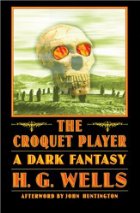 Now, I never intended for Wells to fade into the obscurity of authors long past, though I will admit, three years of not reading him might imply that. Remember my brief mentioning of a reading list for this year--the one Verne failed to make it onto? Well, while visiting my parents, I took a trip back to one of those bookstores in town and happened upon an old friend. Not only were these not in the science fiction section, which is where they usually kept Wells, they were books I'd never heard of before: The Croquet Player and Tono-Bungay. Maybe it was nostalgia or guilt or maybe the fact that neither were science fiction, but I was intrinsically drawn to the two books and quickly snatched them up. I meant to read them last year, but kept putting them off. Now, they've been put on my reading list, and I'm itching to get started on The Croquet Player, which is apparently a horror story.
Will this spark another obsession with an author who used to rank with my top favorites? Well, I've already added six books by Wells to my wishlist. We'll see though.


